Friday, June 20, 2014

July 1923? Kevineen level one and two


As an infant Kevineen delighted himself by playing with the sponge on tubbing night. As a growing boy {under the influence of holy religion which had been instilled into him across his grandmother's knee} he grew more & more pious and abstracted like the time God knows he sat down on the plate of mutton broth. He simply had no time for girls and often used to say that his dearest mother & his dear sisters were good enough for him. At the age of six he wrote a prize essay on kindness to fishes.

As an infant Kevineen delighted himself by playing with the sponge on tubbing night.

pretty harmless foreshadowing of OCD?


As a growing boy {under the influence of holy religion which had been instilled into him across his grandmother's knee} he grew more & more pious and abstracted like the time God knows he sat down on the plate of mutton broth.

transferred from Issy2: "She could do 2 things at same time... sometimes it was how she would be studying something like the day God knows she sat down in the plate of soup (Kevin"

"plate of... broth"?
why was the broth on a plate, and why was a plate where anyone could sit on it?
"mutton broth" sounds poor but funny
why grandmother not mother? was spanking to blame for his OCD?


He simply had no time for girls and often used to say that his dearest mother & his dear sisters were good enough for him.

clearly an incest joke, though from the perspective of the Church there's no innuendo implied at all

cf T&I5 (later): "Isolde! O Isolde! Sister soul and hand!"


At the age of six he wrote a prize essay on kindness to fishes.

Joyce's self-parody
cf kindness to beggars/animals/fishes/bugs (Issy is kind to devil, beggar-saint, dragon)

Flood: Ireland, Its Saints and Scholars 24: (of Saint Columcille) 'His monks were taught by him to observe Obedience, Celibacy, Caution and Reason in Speech, Humility, Hospitality, and Kindness to Animals' 


As an infant shortly after [being] {the little stranger} coming into the world, Kevineen delighted himself by playing with the sponge on tubbing night. As a growing boy under the influence of holy religion which had been instilled into him across his grandmother's knee he grew more & more pious & abstracted like the time God knows he sat down on the plate of mutton broth. He simply had no time for girls and often used to say to his dearest mother & dear sister that his dearest mother & his dear sisters were good enough for him. At the age of six years & six months he wrote a prize essay on kindness to fishes.


As an infant shortly after [being] the little stranger coming into the world, Kevineen delighted himself by playing with the sponge on tubbing night.

VI.A Eumeus (Jul?) "welcome little stranger"
alienated from society even at birth?


As a growing boy under the influence of holy religion which had been instilled into him across his grandmother's knee he grew more and more pious and abstracted like the time God knows he sat down on the plate of mutton broth.


He simply had no time for girls and often used to say to his dearest mother and dear sister that his dearest mother and his dear sisters were good enough for him.


At the age of six years and six months he wrote a prize essay on kindness to fishes.

why add "six months"? to emphasize the number six?


Tuesday, June 10, 2014

July 1923??? Kevineen level four?

Shortly after having come into this vale of tears, the little stranger Kevineen delighted himself by sporting with the sponge on tubbing night. As a growing boy under the influence of holy religion instilled into him across his grandmother's old king Jones's knee he grew more and more pious like the time God knows when ejaculating for forty days indulgence and ten quarantines he sat down on the plate of mutton broth. He simply had no time for girls and things and often used he to say to his dearest mother and dear sisters as how his dearest mother and dear sisters were good enough for him. Of him we are further told that at the age of six he wrote a school prize essay on kindness to freshwater fish.


Shortly after having come into this vale of tears, the little stranger Kevineen delighted himself by sporting with the sponge on tubbing night.

already finding lonely joy in isolation and purification


As a growing boy under the influence of holy religion instilled into him across his grandmother's old king Jones's knee he grew more and more pious like the time God knows when ejaculating for forty days indulgence and ten quarantines he sat down on the plate of mutton broth.

"his grandmother's old king Jones's knee" can this be right?
"when ejaculating for forty days indulgence and ten quarantines"


He simply had no time for girls and things and often used he to say to his dearest mother and dear sisters as how his dearest mother and dear sisters were good enough for him.


Of him we are further told that at the age of six he wrote a school prize essay on kindness to freshwater fish.

changing "fishes" to "freshwater fish" loses the pathos and replaces it with more OCD (why not saltwater fish too?)


Tuesday, May 20, 2014

May 1923?? Issy level one


For her prudence she always left the key of her press in the lock of her press, the pen of the inkbottle in the neck of the ink bottle. Never were they lost. For her learning in geog she knew that Italy was a jackboot, India a pink ham and France a patched quilt. For her charm she knew how to stagemanage her legs in the several positions of goody twoshoes, aunty Nance, stepladder, green peas, love me little, funny toast, lovers' lever, love me long. For her health only her in the house got the measles when she was a bottlefed babe. For her piety Isolde's night prayer and orison so ran: — Howfar wartnevin alibithename Kingcome illbedone nerth tisnevin. Usisday daybread givesdressp sweegivethem dresspas gainstus leesnot tootntation liversm evil Men.
For her learning in zoog she knew lamb, lamb a young sheep. For her domestic economy she cleaned the chimneyflue by setting fire to an Irish Times and hooshing it blazing up the flue and she washed the hall by standing leaving her wet umbrella ?dreeping open in a corner. For her pity there were times she even pitied the damned old devil himself fanning himself with his asbestos slippers in the coolingroom in hell. For her charity one day when it was sneezing cold she met a beggargirl in the park and, having no small change about her, she went behind a bramblebush, slipped off her petticoat and gave it to the beggargirl who instantly disappearing (she having been in point of fact Saint Dympna) along with the petticoat. On another occasion there was a pestilence caused by a certain dragon who said it would go on for ever unless she took off all her clothes and walked from Cape Clear to Mizzen Head. So she did this. And everybody pulled down all their blinds in Ireland. The dragon was then converted and entered a convent. [ms]


we can look first for echoes of Lucia (now 16yo) and Nora, with Scribbledehobble notes under Eveline and Nausikaa

  1. prudence
  2. learning in geog
  3. charm
  4. health
  5. piety
  6. learning in zoog
  7. domestic economy
  8. pity
  9. charity
these seem like a fairly random selection of conventional feminine virtues (minus cooking)


For her prudence she always left the key of her press in the lock of her press, the pen of the inkbottle in the neck of the ink bottle. Never were they lost.

phrases like "For her prudence" usually follow 'she was praised'.
here's a 1706 example referring to the Church of England

(laziness not prudence)


For her learning in geog she knew that Italy was a jackboot, India a pink ham and France a patched quilt.

"geog" is almost always an abbreviation for geography, but one very-very-longshot exception is a Persian village of Nestorians called Geog Tapa

cf VI.A Eveline (July): "York on map red (rose)"

jackboots in 1923 hadn't yet become associated with fascism


pink... ham?

patched quilt

For her charm she knew how to stagemanage her legs in the several positions of goody twoshoes, aunty Nance, stepladder, green peas, love me little, funny toast, lovers' lever, love me long.

"stagemanage" acting class, or dance class?

goody twoshoes [ebook]
aunty Nance ['aunt Nancy' = gay man?]
stepladder [how to climb a ladder modestly?]
green peas
love me little [cf "love me long", below]
funny toast [speech before drinking]
lovers' lever [love her and leave her? or a trick for lovers-plural to control each other's motion??]
love me long [using legs to signal degree of desire??]

Lucia would study Dalcroze c1926:
Dalcroze positions?
cf yoga?
cf kama sutra???
 'If our young friends can become members of a good good dancing-class to which nice young people belong, they will improve in the proper use of arms and legs' [1913]


For her health only her in the house got the measles when she was a bottlefed babe.

breastfeeding was believed better than bottle for resisting contagious diseases like measles
measles was very common and usually mild
(but ctching measles nothing to brag about, unless it strengthened her immunity later? or was such vulnerability considered feminine??)
vaccines introduced 1963


For her piety Isolde's night prayer and orison so ran: —Howfar wartnevin alibithename Kingcome illbedone nerth tisnevin. Usisday daybread givesdressp sweegivethem dresspas gainstus leesnot tootntation liversm evil Men.

ORihzen (what are the implications of this term?)
(this wouldn't be Lucia, surely)

homonyms: wart, alibi, ill, dress, sweet, snot, toot, liver

      Howfar  Our Father
   wartnevin  who art in heaven
alibithename  hallowed be thy name
    Kingcome  Thy kingdom come
   illbedone  Thy will be done
       nerth  on earth
    tisnevin  as it is in heaven
     Usisday  Give us this day
    daybread  our daily bread
 givesdressp  and forgive us our trespasses
sweegivethem  as we forgive those
    dresspas  who trespass
    gainstus  against us
     leesnot  and lead us not
 tootntation  into temptation
     liversm  but deliver us from
    evil Men  evil Amen


For her learning in zoog she knew lamb, lamb a young sheep.

zoography is descriptive zoology
"lamb, lamb" suggests a nursery rhyme?


For her domestic economy she cleaned the chimneyflue by setting fire to an Irish Times and hooshing it blazing up the flue and she washed the hall by standing leaving her wet umbrella ?dreeping open in a corner.

Nora?
theory of chimney sweeps
"Irish Times" limits setting to Ireland
"dreeping" dripping + weeping?


For her pity there were times she even pitied the damned old devil himself fanning himself with his asbestos slippers in the coolingroom in hell.

asbestos slippers
fireproof fabrics made from asbestos have a long history, gradually abandoned for health reasons in the 20thC


For her charity one day when it was sneezing cold she met a beggargirl in the park and, having no small change about her, she went behind a bramblebush, slipped off her petticoat and gave it to the beggargirl who instantly disappeared (she having been in point of fact Saint Dympna) along with the petticoat.

'a sneezing cold' is a phrase
"small change" has referred to coins for centuries
"bramblebush" longshot: Brer Fox in Uncle Remus?

Dymphna
has Issy made up this story to explain where her petticoat disappeared to?


On another occasion there was a pestilence caused by a certain dragon who said it would go on for ever unless she took off all her clothes and walked from Cape Clear to Mizzen Head. So she did this. And everybody pulled down all their blinds in Ireland. The dragon was then converted and entered a convent.

"a certain dragon" individual identity/ personality, able to speak, capable of religion, female gender

cf Lady Godiva

Thursday, May 15, 2014

May 1923?? Issy level two

All her friends admired her brasses She was ?humpy ?full daughter

For her prudence she always left the key of her press in the lock of her press, the bread on the warm table the pen of the inkbottle in the neck of the ink bottle. Never were they lost. No ?igeb ?out ?sump was she. & she was never found out in a lie For her learning in geog she knew that Italy was a jackboot, India a pink ham and France a patched quilt and she could make the map of New Zealand N & S island herself. For her charm she knew how to stagemanage her no nude ?stretches ?under ?a ?straight ?or ?passing ?straight in the several positions of goody twoshoes, aunty Nance, stepladder, green peas, ?Sbella ?carnita love me little, funny toast, lovers' lever, love me long. For her health only her in the house got the measles when she was a bottlefed babe.

For her piety Isolde's nightbede every day ?sent ?on the earth and orison so romped her one little prayer her 5 second patternoster:

— Howfar wartnevin alibithename Kingcome illbedone nerth tisnevin. Usisday daybread givesdressp sweegivethem dresspas gainstus leesnot 2 potatoes liversm evil Men.

For her learning in zoog she knew lamb, lamb a young sheep. For her domestic economy she cleaned the chimney by setting fire to an Irish Times and hooshing it blazing up the flue and she washed the hall by standing leaving her wet umbrella & injurupper golishes dreeping open in a corner. God she had a bit of go in her God she had

For her pity there were times she even pitied the damned old devil himself playing demon patience after his lunch of hot air fanning himself with his asbestos slippers in the coolingroom in hell. She could do 2 things at same time, cook hash & read fairy covered ale Courtship And flahoolagh bless her pretty face she had shaken cocktails, no lie, for [members]{pistoleers gunmen ?parabellums munitioners} from every barony <in> Ireland

For her charity one day when it was sneezing cold she met a beggargirl in the park and, having no small change about her, she went behind a bramblebush, slipped off her sprigged petticoat and gave it to the beggargirl who instantly disappearing (she having been in point of fact Saint Dympna who got up the exhibition of poverty on purpose) along with the petticoat. On another occasion there was a pestilence caused by a certain dragon who said it would go on for ever unless she took off all her glad rags and walked from Ireland her left hand to the sea as far as mother nature allowed. So she did this but she had herself painted green all over her body wherever naturally possible. And everybody pulled down all their blinds in Ireland. The dragon got a grip on the big clean ideals there and then converted and entered a nunnery.

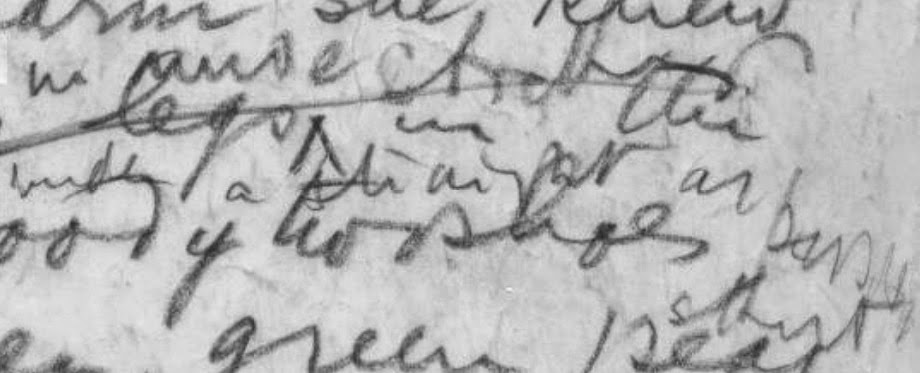
When [her ?Pots] they heard the moaning of the ?shill {like the harbour bar} telling she was off the weakness of death fell on everybody & ?only sometimes it was how she would be studying something like the day God knows she sat down in the plate of soup (Kevin [ms]

the insertions here are especially hard to place, not conforming to the virtues-pattern, so i'm guessing


All her friends admired her brasses She was ?humpy ?full daughter


brassiness? breasts??
humpy/Humphrey??? dutiful???


For her prudence she always left the key of her press in the lock of her press, the bread on the warm table the pen of the inkbottle in the neck of the ink bottle. Never were they lost.

"left" seems to be crossed out
"the bread on the warm table" warmingtable??


No ?igeb ?out ?sump was ?she. & she was never found out in a lie

igit = idiot???
cf VI.A Eveline (May?) "she went in for the intermejet"
sunup? simp?

For her learning in geog she knew that Italy was a jackboot, India a pink ham and France a patched quilt and she could make the map of New Zealand N & S island herself.


For her charm she knew how to stagemanage her ?no nude ?stretches ?under ?a ?straight ?or ?passing ?straight in the several positions of goody twoshoes, aunty Nance, stepladder, green peas, ?Sbella ?carnita love me little, funny toast, lovers' lever, love me long.

under a stranger?

Isabella?


For her health only her in the house got the measles when she was a bottlefed babe.


For her piety Isolde's nightbede every day ?sent ?on the earth and orison so romped her one little prayer her 5 second patternoster: — Howfar wartnevin alibithename Kingcome illbedone nerth tisnevin. Usisday daybread givesdressp sweegivethem dresspas gainstus leesnot 2 potatoes liversm evil Men.


bede = prayer


For her learning in zoog she knew lamb, lamb a young sheep. For her domestic economy she cleaned the chimney by setting fire to an Irish Times and hooshing it blazing up the flue and she washed the hall by standing leaving her wet umbrella & injurupper golishes ?dreeping open in a corner.

india rubber galoshes


God she had a bit of go in her God she had

cf U102: Menton on Molly: "And a good armful she was... She had plenty of game in her then."


For her pity there were times she even pitied the damned old devil himself playing demon patience after his lunch of hot air fanning himself with his asbestos slippers in the coolingroom in hell.

"demon patience" rules (solitaire cardgame)
"lunch of hot air" (interesting image)


She could do 2 things at same time, cook hash & read fairy covered ale Courtship And flahoolagh bless her pretty face she had shaken cocktails, no lie, for [members]{pistoleers gunmen ?parabellums munitioners} from every barony <in> Ireland

read fairy tales??
Anglo-Irish/Hiberno-English flahoolagh: princely, generous (from Irish flaitheamhlach)
Issy as girl, or as wife?
maybe for ROC's guests?


For her charity one day when it was sneezing cold she met a beggargirl in the park and, having no small change about her, she went behind a bramblebush, slipped off her sprigged petticoat and gave it to the beggargirl who instantly disappearing (she having been in point of fact Saint Dympna who got up the exhibition of poverty on purpose) along with the petticoat.

sprigged petticoat


On another occasion there was a pestilence caused by a certain dragon who said it would go on for ever unless she took off all her glad rags and walked from Ireland her left hand to the sea as far as mother nature allowed. So she did this but she had herself painted green all over her body wherever naturally possible. And everybody pulled down all their blinds in Ireland. The dragon got a grip on the big clean ideals there and then converted and entered a nunnery.

from Annals of Four Masters: 'At the time that Muircheartach of the Leather Cloaks was traveling clockwise ('keeping his left hand to the sea') around Ireland taking hostages'

"painted green" cf Berkeley on Leary


When [her ?Pots] they heard the moaning of the ?shill {like the harbour bar} telling she was off the weakness of death fell on everybody & ?only sometimes it was how she would be studying something like the day God knows she sat down in the plate of soup (Kevin


"she was off" ie Issy had sailed with Tristan? or begun her nudegreen march?

cf? VI.A Eveline (Aug?!) "Sure, teasure, a woman does be often saying the things that do have no sense at all "

"studying something" cf doing two things at once?

presumably the soup anecdote was transferred to Kevineen, which hadn't been begun yet


Sunday, April 20, 2014

August 1923: HCE level one

...genesis of Humphrey Coxon's agnomen the most authentic version has it that like Cincinnatus he was one day at his plough when royalty was announced on the highroad. Forgetful of all but his fealty he hastened out on to the road, holding aloft a long perch atop of which a flowerpot was affixed. On his majesty, who was rather longsighted from early youth, inquiring whether he had been engaged in lobstertrapping Humphrey bluntly answered 'No, my liege, I was only a cotching of them bluggy earwigs'. The King upon this smiled heartily and, giving way to that none too genial humour which he had inherited from his great aunt Sophy, turned to two of his retinue the lord of Offaly and the mayor of Waterford (the syndic of Drogheda according to a later version) remarking 'How our brother of Burgundy would fume did he know that he have this trusty vassal a turnpiker who is also an earwicker'. True facts as this legend may be it is certain that from that date all documents initialled by Humphrey bear the sigla H.C.E. and whether he was always Coxon for his cronies and good duke Humphrey for the ragged tiny folk of Lucalizod it was certainly a a pleasant turn of the populace which gave him as sense of those initials the nickname 'Here Comes Everything'. Imposing enough indeed he looked and worthy of that title as he sat on gala nights in the royal booth with wardrobepanelled coat thrown back from a shirt wellnamed a swallowall far outstarching the laundered lordies and marbletopped highboys of the pit. A baser meaning has been read into these letters, the literal sense of which decency can but touch. It has been suggested that he suffered from a vile disease. To such a suggestion the only selfrespecting answer is to affirm that there are certain statements which ought not to be, and one would like to be able to add, ought not to be allowed to be made. Nor have his detractors mended their case by insinuating that he was at one time under the imputation of annoying soldiers in the park. To anyone who knew and loved H - C - E — the suggestion is preposterous. Slander, let it do its worst, has never been able to convict that good and great man of any greater misdemeanour that that of an incautious exposure (and partial at that) in the presence of certain nursemaids whose testimony is, if not dubious, at any rate slightly divergent. [cite]


we see his humble beginnings, then jump momentarily to his local prominence, then to the hints of scandal that motivate much of the book


...genesis of Humphrey Coxon's agnomen the most authentic version has it that like Cincinnatus he was one day at his plough when royalty was announced on the highroad.

humph or hmph expresses disapproval
HCE's hump became a motif [fweet-55]
Smollett spelled his 'Humphry Clinker'

"Coxon" was a rare surname (and rarer 1stname) in Ireland, but was even in the title of a Henry James novel
a 42yo Humphrey Coxon was buried in Pennsylvania in 1900 [more, UK] [anachronism]
cock-son
'coxswain' (navy rank) is pronounced coxon

"agnomen" honorific
"most authentic version" evidence motif
Cincinnatus assumed dictatorship while danger lasted, then immediately returned to plough his small farm

so 1st, HCE is a farmer

"royalty" Irish or English?


'You take the high road'? [wiki] ♬
"highroad" = main road or honorable path
two-word version much more common

FW2: "genesis of Harold or Humphrey Chimpden's occupational agnomen... the best authenticated version,... has it that... like cabbaging Cincinnatus, the grand old gardener was saving daylight... one sultry sabbath afternoon... by following his plough... when royalty was announced... to have been pleased to have halted itself on the highroad"


Forgetful of all but his fealty he hastened out on to the road, holding aloft a long perch atop of which a flowerpot was affixed.

surely he wasn't carrying this rig as he plowed, so he must have picked it up on the way-- maybe mistakenly? or to make a statement about the king? or trying to create a false impression??

from French perche, from Latin pertica (“staff”, “long pole”, “measuring rod”)
(this rare nuance survives from 1st to final draft)

boner with condom? hat-substitute?

earwig trap
inverted flowerpots are still used to trap earwigs [fweet-5]
...but mounting them on a long pole seems inefficient


FW2: "Forgetful of all save his vassal's plain fealty to the ethnarch, Humphrey or Harold... stumbled out... to the forecourts of his public... bearing aloft... a high perch atop of which a flowerpot was fixed earthside hoist with care."


On his majesty, who was rather longsighted from early youth, inquiring whether he had been engaged in lobstertrapping Humphrey bluntly answered 'No, my liege, I was only a cotching of them bluggy earwigs'.

"his majesty" implies it's the king, not just any royalty
"longsighted" sees distant things more clearly
A Pictorial & Descriptive Guide to Bognor &c. Bognor 21: 'Wicker Traps, or "Pots," in which lobsters, crabs and prawns are taken'
there are lobsters on the coast but none in the Liffey (Joyce identified HCE's hotel with the Mullingar Inn)

"my liege" is in Shakespeare (could HCE have started as British?)
"bluggy" well-attested euphemism for bloody (cf T&I5's birdsong's 'u's, also August?)
this contradicts the statement that he was at his plough-- could he have interrupted the plowing to move the bugtrap?
earwigs aren't as harmful to humans or crops as their reputation would suggest
they aren't especially useful as bait

FW2: "On his majesty, who was, or often feigned to be, noticeably longsighted from green youth... asking... to be put wise as to whether paternoster and silver doctors were not now more fancied bait for lobstertrapping, honest blunt Haromphreyld answered...: Naw, yer maggers, aw war jist a cotchin on thon bluggy earwuggers."


The King upon this smiled heartily and, giving way to that none too genial humour which he had inherited from his great aunt Sophy, turned to two of his retinue the lord of Offaly and the mayor of Waterford (the syndic of Drogheda according to a later version) remarking

Parnell's great-aunt Sophia Parnell Evans was supposedly a practical joker (she designed a spectacularly obscene memorial tower for her late husband 15mi from Dublin [streetview now] but it's really just an imitation of the traditional Irish high-tower design) (so does that make this the earliest Parnell reference?) (cf? FW009 "his same marmorial tallowscoop Sophy-Key-Po") (practical jokes ≠ none-too-genial humor)

100ft!
Leix and Offaly: 1st Irish plantation, devastated by Mountjoy
offal = butchers' waste
"syndic" French/Latin/Greek for officer
sin-dick?
Drogheda, was devastated by Cromwell (DRAWhehdah)
"later version" evidence motif

FW2: "Our sailor king... upon this... smiled most heartily... and, indulging that none too genial humour which William the Conk... had inherited... from his greataunt Sophy, turned towards two of his retinue of gallowglasses, Michael, etheling lord of Leix and Offaly, and the jubilee mayor of Drogheda, Elcock, the two scatterguns being Michael M. Manning, protosyndic of Waterford, and an Italian excellency named Giubilei according to a later version... and remarked dilsydulsily:"


'How our brother of Burgundy would fume did he know that he have this trusty vassal a turnpiker who is also an earwicker'.

Edward IV's brother-in-law, Charles of Burgundy, helped him recover the crown c1470

2nd, HCE is turnpike operator

but if HCE is his vassal and turnpiker, doesn't that require they're all in France? (it gets changed to "we" so he can be fuming with envy)
'earwigging' is malicious gossip
Burgundy wine fumes??
Earwicker gravestone [more]
FW2: "how our red brother of Pouringrainia would audibly fume did he know that we have for surtrusty bailiwick a turnpiker who is by turns a pikebailer no seldomer than an earwigger!"

(George W Bush also liked to give his associates nicknames, most memorably 'Turd Blossom' for Karl Rove)

True facts as this legend may be it is certain that from that date all documents initialled by Humphrey bear the sigla H.C.E. and whether he was always Coxon for his cronies and good duke Humphrey for the ragged tiny folk of Lucalizod it was certainly a a pleasant turn of the populace which gave him as sense of those initials the nickname 'Here Comes Everything'.

(has the king officially made him a duke?)

'Duke Humphrey' (spelled variously) was by 1600 a euphemism for having nothing to eat, by a London geographic accident involving the poor and a particular monument. Around the same time Thomas Nash dedicated a book to a tobacconist named Humphrey King, using language very similar to Joyce's about HCE.

"ragged" = poor
"tiny folk" = children (esp. in titles of 1920s book series)

VI.B10.33f (Nov22): "Lucalizod"
"Lucalizod" also in T&I5 around this time
approximate location: outskirts of Dublin
anachronism: Lucozade (soft drink)

"pleasant turn" (hints it's temporary/unexpected)
Here Comes Everybody: nickname of H.C.E Childers, 19th century Irish politician
"Everything" is much more ominous sounding

FW2: "The great fact emerges that after that historic date all holographs so far exhumed initialled by Haromphrey bear the sigla H.C.E. and while he was only and long and always good Dook Umphrey for the hungerlean spalpeens of Lucalizod and Chimbers to his cronies it was equally certainly a pleasant turn of the populace which gave him as sense of those normative letters the nickname Here Comes Everybody."


Imposing enough indeed he looked and worthy of that title as he sat on gala nights in the royal booth with wardrobepanelled coat thrown back from a shirt wellnamed a swallowall far outstarching the laundered lordies and marbletopped highboys of the pit.

"royal booth" (guest of royalty, or royalty himself now?)
how far into the future have we jumped?

Booth: Lincoln's assassin (shot him in Ford Theater)
'wardrobe' can be clothes or furniture to guard clothes (warde-robe)
'panelled coat' is something [pix]

swallowtail
cf FW279.F07 "If it's me chews to swallow all you saidn't you can eat my words for it as sure as there's a key in my kiss."
cf Berkeley: Latin "absorbere" = to swallow
outstretch?
starched more/better
marbletopped highboy
pit: the part of the ground-floor of a theatre behind the stalls

FW2: "An imposing everybody he always indeed looked... well worthy of any and all such universalisation, every time he continually surveyed... the truly catholic assemblage gathered... to clapplaud... Mr Wallenstein Washington Semperkelly's immergreen tourers in a command performance... from his viceregal booth... in a wardrobepanelled tuxedo completely thrown back from a shirt well entitled a swallowall, on every point far outstarching the laundered clawhammers and marbletopped highboys of the pit" [last part little changed]


A baser meaning has been read into these letters, the literal sense of which decency can but touch. It has been suggested that he suffered from a vile disease. To such a suggestion the only selfrespecting answer is to affirm that there are certain statements which ought not to be, and one would like to be able to add, ought not to be allowed to be made.

"touch" [fweet-140] the sexiest sense-modality

HCE ?= his cock exposed; he caught e...?
syphilis? a sexual perversion?

The Quarterly Review on Ulysses, 1922: 'When we are given the details of the skin disease of an Irish peer, famous for his benefactions, we feel a genuine dislike of the writer. There are some things which cannot and, we should like to be able to say, shall not be done.' referring to U76: "Still the other brother lord Ardilaun has to change his shirt four times a day, they say. Skin breeds lice or vermin."

FW2: "A baser meaning has been read into these characters the literal sense of which decency can safely scarcely hint. It has been blurtingly bruited... that he suffered from a vile disease... To such a suggestion the one selfrespecting answer is to affirm that there are certain statements which ought not to be and, one should like to hope to be able to add, ought not to be allowed to be made." [very few changes from 1st to final draft]


Nor have his detractors mended their case by insinuating that he was at one time under the imputation of annoying soldiers in the park.

"mended their case" suggesting a case that's been broken (torn cloth?)

"detractors mended... insinuating... at one time... imputation" (layers of defensive doubt)
"annoying soldiers" is sometimes used to describe light battles; 'annoying citizens' is much more common and usually much less severe

cf T&I1: "And he hunting about for his speckled trousers in Palmerston park"

FW2: "Nor have his detractors... mended their case by insinuating that, alternatively, he lay at one time under the ludicrous imputation of annoying Welsh fusiliers in the people's park."

People's Park, DĂșn Laoghaire [pix]


To anyone who knew and loved H - C - E — the suggestion is preposterous. Slander, let it do its worst, has never been able to convict that good and great man of any greater misdemeanour that that of an incautious exposure (and partial at that) in the presence of certain nursemaids whose testimony is, if not dubious, at any rate slightly divergent.

"good and great man" cliche
"great... greater" corrected

this throwaway remark was to become the dramatic fulcrum for the whole book, the sin in the park:
VI.B3.153a (June?): "It is not true that Pop was homosexual he had been arrested at the request of some nursemaids to whom he had temporarily exposed himself in the Temple gardens" ("Pop" in the early notes became HCE)
this has been traced to a footnote in the appendix to Frank Harris's Oscar Wilde, specifically a correction by Robert Ross concerning OW's grandfather-in-law: 'Your memory is at fault here. The charge against Horatio Lloyd was of a normal kind. It was for exposing himself to nursemaids in the gardens of the Temple' (ie 'normal' as opposed to homosexual: Harris had claimed he was 'more than suspected of sexual viciousness')


'Her grandfather John Horatio Lloyd had, in the 1830s [c1835, 37yo], ‘exposed himself in the Temple Gardens’ and run ‘naked in the sight of some nursemaids’, thus losing the opportunity to become solicitor-general. He ‘was forced to retire from political and legal work for four years’, Franny Moyle writes in her illuminating biography of Constance, ‘during which time he went abroad to Athens and became a director of the Ionian Bank’.' [cite] [more] [obit]

"temporarily" as opposed to permanently? momentarily
"temporarily... Temple"
"Temple gardens" was a short street just north of Palmerston Park [1909 map] [pix] [1901 census]
'gardens of the Temple' would instead have referred to London [pix]

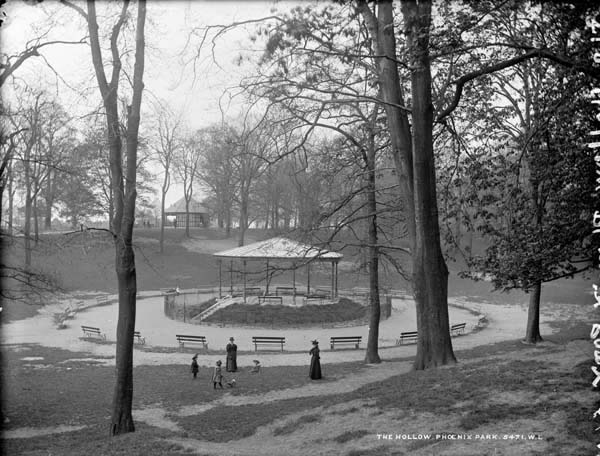
it seems unlikely Joyce had any specific relevant associations to the Dublin street, and the eventual cited locale would be (via VI.B10.79r from Dec22) "the rushy hollow" aka The Hollow, Phoenix Park

the Hollow c1900 w/bandstand (not remotely rushy)
"certain nursemaids" indefinite number, evidence motif?
nursemaid = nanny (not nurse)


"divergent" remarkably this word survives as "visibly divergent" (maybe they were spreading their legs too?) parallax motif?
one "testimony" can't really be divergent, so this will be corrected to "testimonies"

FW2: "To anyone who knew and loved... H. C. Earwicker... the mere suggestion... rings particularly preposterous... Slander, let it lie its flattest, has never been able to convict our good and great and no ordinary Southron Earwicker... of any graver impropriety than that... of having behaved with an ongentilmensky immodus opposite a pair of dainty maidservants... whose... testimonies are, where not dubiously pure, visibly divergent on minor points touching the intimate nature of this, a first offence... which was admittedly an incautious but, at its wildest, a partial exposure"


Thursday, April 17, 2014

August 1923? HCE level two

Concerning the genesis of Harold or Humphrey Coxon's agnomen and discarding finally those theories which would link him either with the Glues & Gravys & Earwickers of Sidleham in the hundred of manhood or proclaim him a descendant of vikings who had settled in Herwick (?) or Erwick (?) the most authentic version has it that it was this way. Like Cincinnatus the G.O.G. (grand old gardener) was one sabbath day following his plough for rootles in the rear garden of his Royal Marine Hotel when royalty was announced by runner to have been pleased to halt on on the highroad along which a dogfox had cast. Forgetful of all but his fealty he stayed not to saddle or yoke but he stumbled hotface out of his forecourts on to the road in his surcingle plus fours & bulldog boots coated with red marl jingling his turnpike keys a sweatdrenched bandana hanging from his coat pocket holding aloft among the fixed pikes of the royal hunting party a long perch atop of which a flowerpot was affixed. On his majesty, who was noticeably longsighted from his early youth, inquiring whether he had been engaged in lobstertrapping honest Humphrey bluntly answered very similarly: 'No, my liege, I was only a cotchin of them bluggy earwigs'. The king who held a draught of obvious water in his hand upon this smiled heartily beneath his walrus moustaches and giving way to that none too genial humour which William the Conk had inherited from his great aunt Sophy, turned towards two gunmen of his retinue, the lord of Offaly and the mayor of Waterford (the second gun being syndic of Drogheda according to a later version cited by the learned Kanavan) remarking 'Holybones, How our brother of Burgundy would fume did he know that he have for trusty vassal a turnpiker who is also an earwicker'. are these the True facts are recorded in as this legend? We shall perhaps see. But it is certain that from that historic date all documents initialled by Humphrey bear the sigla. H.C.E. and whether he was always Coxon for his cronies and good duke Humphrey for the ragged tiny folk of Lucalizod it was certainly a pleasant turn of the populace which gave him as sense of these initials the nickname 'Here Comes Everybody'. An Imposing everybody indeed he looked and worthy of that title as he surveyed the playhouse on gala nights from the royal booth where he sat with all his house with broadstretched kerchief cooling neck & shoulders & wardrobepanelled tuxedo thrown back from a shirt wellnamed a swallowall far outstarching the laundered clawhammers and marbletopped highboys of the pit. A baser meaning has been read into these letters, the literal sense of which decency dare but touch. It has been suggested that he suffered from a vile disease. To such a suggestion the only selfrespecting answer is to affirm that there are certain statements which ought not to be, and one would like to be able to add, ought not to be allowed to be made. There was a case of the kind implicating a man named Lyons who was posted at Mallon's and years afterward dropped dead whilst waiting for a chop in Hawkins street. Nor have his detractors who an imperfectly warmblooded race apparently think him capable of any and every enormity recorded to the discredit of the Juke & Kellikek families mended their case by insinuating that he was at one time under the ludicrous imputation of annoying soldiers in the rushes. To anyone who knew and loved H.C.E. this suggestion is preposterous. Slander, let it do its worst, has never been able to convict that good and great man of any worse impropriety than that of having behaved in an ungentlemanly manner in the presence of a pair of maidservants in the rushy hollow whither nature as they alleged had spontaneously & at the same time sent them both whose testimonies are, if not dubious, at any rate slightly divergent on minor points touching what was certainly an incautious, but at the most, a partial exposure with attenuating circumstances. during an abnormal S Martin's summer. [FDV]


Concerning the genesis of Harold or Humphrey Coxon's agnomen and discarding finally those theories which would link him either with the Glues & Gravys & Earwickers of Sidleham in the hundred of manhood or proclaim him a descendant of vikings who had settled in Herwick (?) or Erwick (?) the most authentic version has it that it was this way.

"Harold"?!
herald?

A Pictorial & Descriptive Guide to Bognor &c. Chichester 54: 'Sidlesham Church is an Early English structure worthy of notice, and an examination of the surrounding tombstones should not be omitted if any interest is felt in deciphering curious names, striking examples being Earwicker, Glue, Gravy, Boniface, Anker, and Northeast... From Chichester to Selsey Hill runs a light railway called the Hundred of Manhood and Selsey Tramway' (Sidlesham is in the Hundred of Manhood, the extreme southwestern Hundred (county division) of Sussex; Joyce stayed in Bognor, a few miles from there, in summer 1923)

Herrick (or Erick): the maiden name of Swift's mother [cite]
the 1911 census had an Erwick (no Irish Herwicks)
her wick
the old, correct, pronunciation of the name Earwicker is 'Erricker'
(do we care whether this is Ireland or England?)

FW2: "concerning the genesis of Harold or Humphrey Chimpden's occupational agnomen... and discarding once for all those theories... which would link him back with... the Glues, the Gravys, the Northeasts, the Ankers and the Earwickers of Sidlesham in the Hundred of Manhood or proclaim him offsprout of vikings who had... seddled hem in Herrick or Eric, the best authenticated version... has it that it was this way."


Like Cincinnatus the G.O.G. (grand old gardener) was one sabbath day following his plough for rootles in the rear garden of his Royal Marine Hotel when royalty was announced by runner to have been pleased to halt on on the highroad along which a dogfox had cast.

Tennyson 1842, 'Lady Clara Vere de Vere': 'The grand old gardener and his wife Smile at the claims of long descent' (the first verse was changed to 'The gardener Adam and his wife' because of frequent letters to Tennyson from friends asking for an explanation) [etext]

Hamlet V.1.27-35: 'CLOWN:... There is no ancient gentlemen but gard'ners, ditchers, and grave-makers. They hold up Adam's profession... 'A was the first that ever bore arms... The Scripture says Adam digg'd. Could he dig without arms?'

U-17: "What would be his civic functions and social status among the county families and landed gentry? Arranged successively in ascending powers of hierarchical order, that of gardener, groundsman, cultivator, breeder..." (so, starting here at the very bottom)

Grand Old Man: Gladstone's nickname
cf ROC4 (July) "googs"

"sabbath" working on Sunday
"following" plow pulled by horse
VI.B10.23k: "rootles" is always a verb?!
gathering root vegetables like potatoes or turnips that the plow turns up;?

Royal Marine Hotel, Dunleary [site] (on coast, so lobstertrapping?)
his hotel (cf Finn's Hotel hypothesis)

Royal Marine Hotel
could ROC's roundtable be a later stage in Pop/HCE's life story? ie, he's not king, yet?

VI.B10.58e: "by runner to Luxor (mail)" Irish Times 30Nov 1922: 'Egyptian Treasure': 'The Cairo Correspondent of The Times yesterday telegraphed a long message, dated from the Valley of the Kings (by runner to Luxor)'
(what caught JAJ's interest here? surely the rare medium of communication?)
a servant runs ahead of the royal party to prepare the way

now it's made clear they're foxhunting
VI.B10.05i: "dogfox" Quarterly Review: 'It is hard to understand why dog-foxes are so often seen about earths which contain cubs'
VI.B10.05c: "casts along shore (fox)" Quarterly Review: 'The fox had vanished... Exhaustive casts along the shore failed to recover the line'

FW2: "like cabbaging Cincinnatus, the grand old gardener was... one sultry sabbath afternoon... following his plough for rootles in the rere garden of... ye olde marine hotel, when royalty was announced by runner to have been pleased to have halted itself on the highroad along which a leisureloving dogfox had cast"


Forgetful of all but his fealty he stayed not to saddle or yoke but he stumbled hotface out of his forecourts on to the road in his surcingle plus fours & bulldog boots coated with red marl jingling his turnpike keys a sweatdrenched bandana hanging from his coat pocket holding aloft among the fixed pikes of the royal hunting party a long perch atop of which a flowerpot was affixed.

"forecourts" = any open area in front of a building (UK)
he wouldn't be plowing the forecourts, would he? but he might have gone there to meet the runner

VI.B10.30j: "surcingles" Leader 11 Nov 1922, 327/1: 'Our Ladies' Letter': 'Mrs Joe was out last Sunday, and if you heard her about the military weddings! The officers "with their surcingles!" that kill her'
surcingle = girdle or belt confining a cassock?
sir-single

surcingles??
VI.B10.90g: "plus fours (shoes)" (wrong?!)

plus-fours
"forecourts... plus fours"
"bulldog boots" were something, usually worn by women? maybe sturdy Jamaican 'rope-soled slippers' later made with waste car-tire rubber and called 'power shoes' [pdf-p114]

marl describes the chemistry not the consistency

"turnpike keys" nobody but Joyce ever used the plural; the singular was the title of a history of turnpikes
(did turnpikes need keys in those days? the custodian was supposed to collect a toll for road maintenance, but not of course from the king)

pikes
"turnpike keys... fixed pikes"

FW2: "Forgetful of all save his vassal's plain fealty... Humphrey or Harold stayed not to yoke or saddle but stumbled out hotface as he was (his sweatful bandanna loose from his pocketcoat), hasting to the forecourts of his public in topee, surcingle, solascarf and plaid, plus fours, puttees and bulldog boots ruddled cinnabar with flagrant marl, jingling his turnpike keys and bearing aloft amid the fixed pikes of the hunting party a high perch atop of which a flowerpot was fixed"


On his majesty, who was noticeably longsighted from his early youth, inquiring whether he had been engaged in lobstertrapping honest Humphrey bluntly answered very similarly: 'No, my liege, I was only a cotchin of them bluggy earwigs'.

VI.B10.84i: "answered very similarly"
similar to what/whom??

FW2: "On his majesty, who was... noticeably longsighted from green youth... asking... whether paternoster and silver doctors were not now more fancied bait for lobstertrapping, honest blunt Haromphreyld answered... very similarly...: Naw, yer maggers, aw war jist a cotchin on thon bluggy earwuggers."


The king who held a draught of obvious water in his hand upon this smiled heartily beneath his walrus moustaches and giving way to that none too genial humour which William the Conk had inherited from his great aunt Sophy, turned towards two gunmen of his retinue, the lord of Offaly and the mayor of Waterford (the second gun being syndic of Drogheda according to a later version cited by the learned Kanavan) remarking 'Holybones, How our brother of Burgundy would fume did he know that he have for trusty vassal a turnpiker who is also an earwicker'.

VI.B10.11c: "a draught of obvious water"
maybe cf the waters of oblivion??
why "obvious"? is he a notorious teetotaler?  is the vessel clear?

VI.B10.01q: "walrus"
VI.B10.21n: "William the Conk" Sunday Pictorial 29 Oct 1922, 9/1: 'Review of "The Nine O'Clock Revue" at the Little': 'Who can resist Beatrice Lillie? I can't. Hear her sing her ancestry in "William the Conk!" with moustache and bowler hat'
"William the Conk" was a comic song about ancestry sung by Beatrice Lillie in drag in 1922 (she may also have contributed to the walrus moustaches and Sophy's humour).

Beatrice Lillie singing about Wm the Conk

VI.B10.06i: "2 guns (2 men)" Quarterly Review: 'rabbiting in one of his own woods with a couple of companions — quite an informal party, just the two guns and a dog'

the 1911 census has six Kanavans (and 1200 Canavans)
MJ Canavan was a US historian

VI.B10.101i: "holy bones!" not usually an exclamation (cf 'Holy smoke!' etc)

FW2: "Our sailor king, who was draining a gugglet of obvious adamale... upon this, ceasing to swallow, smiled most heartily beneath his walrus moustaches and, indulging that none too genial humour which William the Conk... had inherited... from his greataunt Sophy, turned towards two of his retinue of gallowglasses, Michael, etheling lord of Leix and Offaly, and the jubilee mayor of Drogheda, Elcock, the two scatterguns being Michael M. Manning, protosyndic of Waterford, and an Italian excellency named Giubilei according to a later version cited by the learned scholarch Canavan... and remarked dilsydulsily: Holybones of Saint Hubert, how our red brother of Pouringrainia would audibly fume did he know that we have for surtrusty bailiwick a turnpiker who is by turns a pikebailer no seldomer than an earwigger!"


are these the True facts are recorded in as this legend? We shall perhaps see. But it is certain that from that historic date all documents initialled by Humphrey bear the sigla. H.C.E. and whether he was always Coxon for his cronies and good duke Humphrey for the ragged tiny folk of Lucalizod it was certainly a pleasant turn of the populace which gave him as sense of these initials the nickname 'Here Comes Everybody'.

VI.B10.39g: "Are they? We shall see" (maybe? Balfour: The Foundations of Belief 217: 'are these results rational... or are they, like a schoolboy's tears over a proposition of Euclid, consequences of reasoning, but not conclusions from it? In order to answer this question it may be worth while to consider it in the light of an example')

FW2: "are these the facts of his nominigentilisation as recorded and accolated in both or either of the collateral andrewpaulmurphyc narratives? ...We shall perhaps not so soon see... The great fact emerges that after that historic date all holographs so far exhumed initialled by Haromphrey bear the sigla H.C.E. and while he was only and long and always good Dook Umphrey for the hungerlean spalpeens of Lucalizod and Chimbers to his cronies it was equally certainly a pleasant turn of the populace which gave him as sense of those normative letters the nickname Here Comes Everybody."


An Imposing everybody indeed he looked and worthy of that title as he surveyed the playhouse on gala nights from the royal booth where he sat with all his house with broadstretched kerchief cooling neck & shoulders & wardrobepanelled tuxedo thrown back from a shirt wellnamed a swallowall far outstarching the laundered clawhammers and marbletopped highboys of the pit.

"a sweatdrenched bandana hanging from his coat pocket... with broadstretched kerchief cooling neck & shoulders"

VI.B10.117g: "tuxedos"
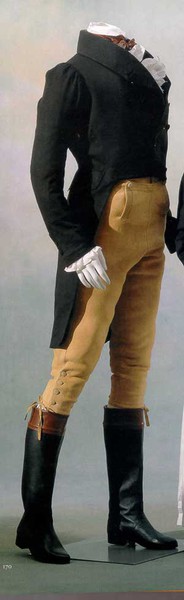
clawhammer coat
(do swallowtails + clawhammers anticipate the 'divergent tails/tales' motif?)

FW2:"An imposing everybody he always indeed looked... and magnificently well worthy of any and all such universalisation, every time he continually surveyed... the truly catholic assemblage gathered together in that king's treat house... to clapplaud... a command performance... on all horserie show command nights from his viceregal booth... where... this folksforefather all of the time sat, having the entirety of his house about him, with the invariable broadstretched kerchief cooling his whole neck, nape and shoulderblades and in a wardrobepanelled tuxedo completely thrown back from a shirt well entitled a swallowall, on every point far outstarching the laundered clawhammers and marbletopped highboys of the pit"


A baser meaning has been read into these letters, the literal sense of which decency dare but touch. It has been suggested that he suffered from a vile disease. To such a suggestion the only selfrespecting answer is to affirm that there are certain statements which ought not to be, and one would like to be able to add, ought not to be allowed to be made.


FW2: "A baser meaning has been read into these characters the literal sense of which decency can safely scarcely hint. It has been blurtingly bruited... that he suffered from a vile disease... To such a suggestion the one selfrespecting answer is to affirm that there are certain statements which ought not to be and, one should like to hope to be able to add, ought not to be allowed to be made."


There was a case of the kind implicating a man named Lyons who was posted at Mallon's and years afterward dropped dead whilst waiting for a chop in Hawkins street.

cf Bantam Lyons in Ulysses
"posted" can mean either 'assigned a job posting' or 'reported missing, on a poster'

VI.B10.102h: "posted at Lloyd's as missing" Irish Times 9 Jan 1923, 4/5: 'Toll of the Sea': 'In the year 1922 twenty-one ships have been posted at Lloyds as "missing" and a ship "missing" at Lloyds seldom reappers'

John Mallon: superintendent of Dublin police at time of the Phoenix Park murders

VI.B10.66c: "whilst waiting for chop he dropped dead"
"a chop" meat at butcher or restaurant?

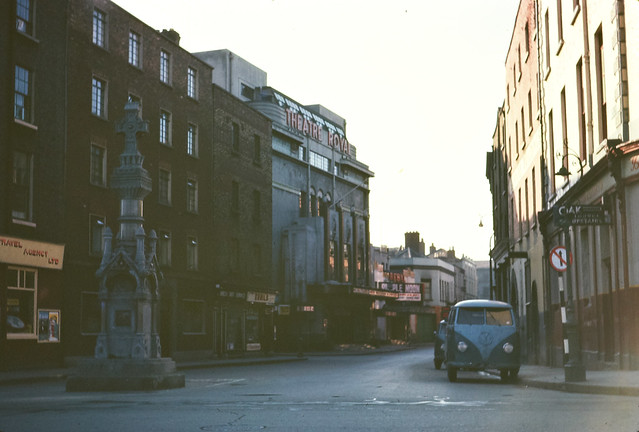
[map] Theatre Royal, Hawkins St

Hawkins St, 1962

FW2: "there is said to have been... some case of the kind implicating... a quidam... abhout that time stambuling haround Dumbaling... who has remained topantically anonymos but... was, it is stated, posted at Mallon's... and years afterwards... tropped head... waiting his first of the month froods turn for thatt chopp... on the old house for the chargehard, Roche Haddocks off Hawkins Street."


Nor have his detractors who an imperfectly warmblooded race apparently think him capable of any and every enormity recorded to the discredit of the Juke & Kellikek families mended their case by insinuating that he was at one time under the ludicrous imputation of annoying soldiers in the rushes.

VI.B10.31j: "imperfectly warmblooded"
Daily Mail 15 Nov 1922, 8/4: 'The Wild Things in Winter': 'hedgehog, dormouse and bat are examples of creatures which have only... reached an imperfectly warm-blooded state... So at... cold weather they... lapse into a state of unconsciousness'

VI.B10.108a: "Juke & Kellikek family — bred 250 criminals"
Juke and Kallikak: American families of supposedly-hereditary degenerates, the subject of Goddard's 'The Kallikak Family' (1912) and Dugdale's 'The Jukes' (1877)

FW2: "Nor have his detractors, who, an imperfectly warmblooded race, apparently conceive him as... capable of any and every enormity... recorded to the discredit of the Juke and Kellikek families, mended their case by insinuating that, alternatively, he lay at one time under the ludicrous imputation of annoying Welsh fusiliers in the people's park."


To anyone who knew and loved H.C.E. this suggestion is preposterous. Slander, let it do its worst, has never been able to convict that good and great man of any worse impropriety than that of having behaved in an ungentlemanly manner in the presence of a pair of maidservants in the rushy hollow whither nature as they alleged had spontaneously & at the same time sent them both

VI.B10.91e: "behaved in a gentlemanly manner"
VI.B10.79r: "the rushy hollow"
VI.B10.77h: "Nature sends me to do so (piss) W"

FW2: "To anyone who knew and loved... H. C. Earwicker... the mere suggestion... rings particularly preposterous."
FW2: "Slander, let it lie its flattest, has never been able to convict our good and great and no ordinary Southron Earwicker, that homogenius man... of any graver impropriety than that... of having behaved with an ongentilmensky immodus opposite a pair of dainty maidservants in the swoolth of the rushy hollow whither... Dame Nature... had spontaneously and about the same hour of the eventide sent them both"


whose testimonies are, if not dubious, at any rate slightly divergent on minor points touching what was certainly an incautious, but at the most, a partial exposure with attenuating circumstances. during an abnormal S Martin's summer.

extenuating

St Martin's day = November 11
cf Indian summer

FW2: "but whose... testimonies are, where not dubiously pure, visibly divergent... on minor points touching the intimate nature of this... which was admittedly an incautious but, at its wildest, a partial exposure with such attenuating circumstances... as an abnormal Saint Swithin's summer"